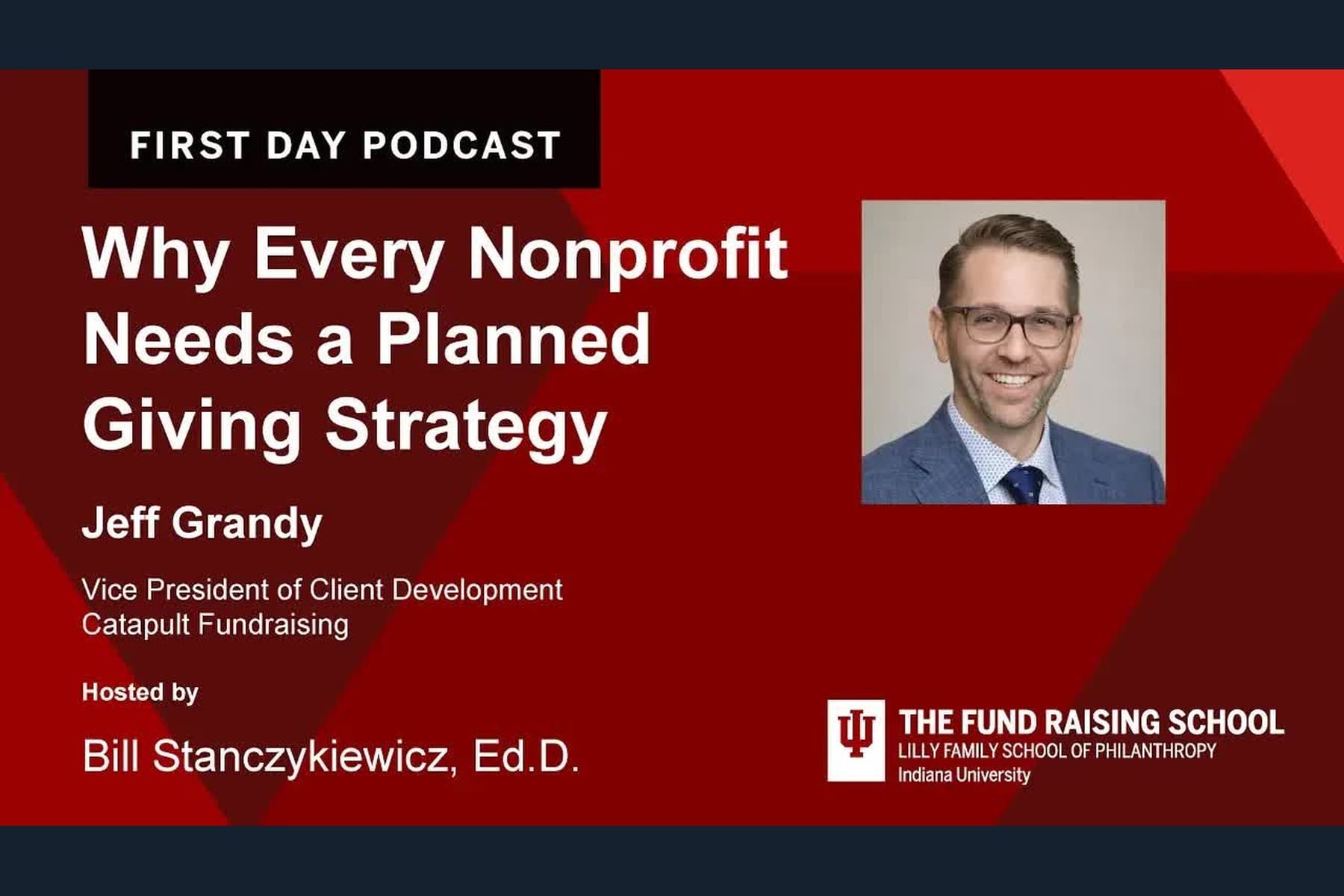
Featuring Jeff Grandy, Vice President of Client Development, Catapult Fundraising
Every fundraiser has heard the story. A donor nobody had ever met leaves the organization a seven figure gift out of the blue, the news covers it, and the development office spends the next year hoping lightning strikes twice.
Host Bill Stanczykiewicz, Ed.D., opened this episode of the First Day podcast with exactly that kind of story: a library foundation that raised its campaign goal by a million dollars after an estate attorney called about a frugal, unmarried donor who had borrowed books her whole life and left her estate to the library. Nobody at the foundation had ever heard her name.
Then he made the point that sets up the whole conversation. Those gifts make the news because they are unusual. They are not typical. So who is the typical planned gift donor, and how do you find them before an attorney calls?
That is where our own Jeff Grandy, Vice President of Client Development at Catapult Fundraising, spends his days. Here is what he shared on the podcast, which is produced by The Fund Raising School at the Indiana University Lilly Family School of Philanthropy.
Legacy giving is not about death. It is about a life well lived.
Jeff came to legacy giving through public media, hired as a major gift officer in a small shop with a growing portfolio and a budget that kept going up. What changed his career was not a technique. It was a realization about what the conversation actually is.
“Sometimes there is a preconceived notion that legacy giving is all about death and dying, and it is the complete opposite,” he said. “It is all about how the donor has a life well lived. What are the values the donor espouses, and what are those values they want to see continue in your organization?”
He told the story of an early donor visit, a woman named Bev, sitting with her stoic husband while Jeff walked them through how she could give now and give later. When he saw her eyes well up, the lesson landed.
Legacy giving is important because it changes the donor’s life.
Bill added the research context fundraisers rarely hear: work from Russell James III has found that annual giving can increase by as much as 75% after a legacy gift is documented, because donors want to experience the joy of that decision while they are still here. The legacy conversation is not a threat to the annual fund. It often feeds it.
One word replaces the whole demographic checklist: loyalty
Ask the research who leaves a bequest and you get a list of characteristics long enough to paper a wall. Jeff described teaching that list at AFP ICON, then advancing to a slide with a single word on it.
“When you see loyal giving patterns, it does not matter what zip code they live in, what car they drive, who they are, how they spell their last name,” he said. “When they demonstrate loyalty, that is someone you want to have a conversation with.”
In Catapult’s own client work, two thresholds have become the practical definition of loyalty for a legacy pull:
- 11 or more years of consecutive giving
- 14 or more years of non-consecutive giving
Jeff was careful to frame those as sweet spots drawn from Catapult’s partnerships rather than published research. His advice was to run both pulls through your own CRM and see who appears.
Do not skip the non-consecutive donors
This was the most practical five minutes of the episode. Most organizations run loyalty reports on consecutive gifts inside their own fiscal year, and that quietly deletes some of their best prospects.
“Donors do not think in your fiscal year,” Jeff said. A donor who gives every December but misses one odd-month fiscal cutoff looks lapsed in your report and loyal in real life.
Bill layered on the tax-behavior reasons the gap years keep growing. With a higher standard deduction, some donors bunch, saving their charitable dollars for two or three years so one year’s giving clears the deduction. Others route gifts through a donor advised fund and let it grow before granting. Some simply rotate their nonprofits. None of that is disloyalty. It is calendar mechanics.
The $25 donor belongs on your legacy list
Jeff’s example was a donor giving $25 a year for the last 11 years. Bill stopped to make sure listeners caught it: we are talking about all giving levels, not the top of the gift range chart.
“Legacy gifts are not defined by the dollar amount,” Jeff said. “It does not matter if it is a future gift of $1,000 or a future gift of $10 million. There is something innate in that person that they desire to see their passion and their values live on. It is loyalty patterns.”
These donors, he noted, are usually not the ultra high net worth prospects who ask to review your 990 and meet your board chair. They are people who see your organization as a conduit for their generosity.
Loyalty shows up in more places than the gift table
Asked what else to watch for beyond giving history, Jeff turned the question around: how else do people experience your mission?
- Volunteers who have given years of their time
- Alumni of a school, college, or independent school
- Grateful patients at a hospital or health system
- Audiences, members, and subscribers who engage constantly and have never given a dollar
In public media, he pointed out, there were loyal people he would never have called because they had never made a gift, yet they tuned in every single day. That is loyalty too, and it argues for introductory legacy messaging aimed at everyone who engages with your mission.
His language rule for that messaging is worth writing on a sticky note: skip the $10 words you would get from an estate planning attorney. Use warm, welcoming language about a will, and come at it from the perspective of helping people plan.
How to open the first conversation
Bill asked the question every gift officer wants answered. You have the list. Now what do you actually say? Jeff’s answer had four parts.
- Pick up the phone. Tell them you are calling with a letter or an email first, then call. Leave a good voicemail if they do not answer, and call back on different days of the week.
- Lead with celebration, then curiosity. You have been giving for 25 years. Why? What have you most enjoyed about our work? The data told you they are loyal. The call tells you why.
- Listen for values, then share a story. When their values come up, share how another donor gave, with that donor’s permission. “Get rid of the statistics,” Jeff said. Whether you sent home 500 backpacks on a Friday does not land. Who is the one girl you fed all weekend?
- Give yourself homework. End every conversation with a next step and a next date. Watch for the signals in between: leaning in, a lower and quieter voice, and the leave-behind material that comes back with them on the second or third visit.
Two timing notes from Catapult’s programs came up here. About a quarter of the donors we reach ask a version of the same question: why did it take you this long to find me? Many have already named the organization, and in those cases you want to verify that the intention is not restricted in a way that will encumber the organization later. For everyone else, expect roughly six touches over six to eighteen months before you know what is possible. Conversations can take years, and that is normal.
What to say when leadership says “but we still need the annual fund”
Every gift officer meets this objection, usually from a CFO or a board that wants dollars in the door this quarter. Jeff’s response has two halves.
The first is the cost of waiting. “If we choose not to invest today, that donor is going to give somewhere else,” he said, because other organizations have a more advanced legacy program than yours. Choosing short term revenue over long term sustainability keeps a shop chasing its tail.
The second is more disarming: a healthy annual fund is the argument for starting legacy work, not against it. If your renewals and upgrades are humming and your annual giving already feeds a mid-level and major gift pipeline, you have the systems to handle legacy documentation and stewardship. And if your organization has even one person on finance, find out their favorite dessert or soft drink and invite them into the conversation early, because recording and honoring a planned gift correctly is part of the system.
Bill closed with the piece of school research that makes the risk concrete: very few people give to only one nonprofit. Your loyal donor is probably supporting three, five, or seven organizations, and most charitable giving happens because someone asked. If you are not asking about a planned gift, somebody else is.
Five things to do this month
- Pull two reports: 11 or more consecutive years of giving, and 14 or more non-consecutive years. Ignore gift size.
- Add your long-tenured volunteers, alumni, grateful patients, and members to the list, even the ones who have never given.
- Rewrite one paragraph of legacy copy in plain, warm language about making a will, with no attorney vocabulary.
- Call ten of those donors this month with one goal: thank them and ask why they have stayed so loyal.
- Bring your finance colleague into the conversation before the first commitment arrives, not after.
If ten calls a month is not going to get you through a file of a thousand loyal donors, that is the gap our Legacy Call program was built to close: a two-tier calling model that qualifies loyal donors and hands genuine legacy conversations to gift planning specialists. You can also grade your own loyalty pool in a few minutes, or start a conversation with our team.
Sources: quotations and paraphrases are drawn from “Why Every Nonprofit Needs a Planned Giving Strategy”, First Day podcast, The Fund Raising School, Indiana University Lilly Family School of Philanthropy, published September 21, 2026, hosted by Bill Stanczykiewicz, Ed.D. Research on annual giving after a documented legacy gift is attributed in the episode to Russell James III. Loyalty thresholds, the share of donors who have already named an organization, and visit-count ranges reflect Catapult Fundraising’s own client experience as described in the episode and are not published industry statistics.