
Nonprofits rarely raise significant money through one program alone. The organizations that consistently grow their donor base treat capital campaigns, mid-level donor engagement, and legacy giving as three connected stages of the same relationship, not three separate initiatives run by three separate teams. Below is the best-practice playbook Catapult Fundraising uses across capital campaigns, mid-level donor engagement, and legacy giving programs nationwide.
Capital campaign best practices
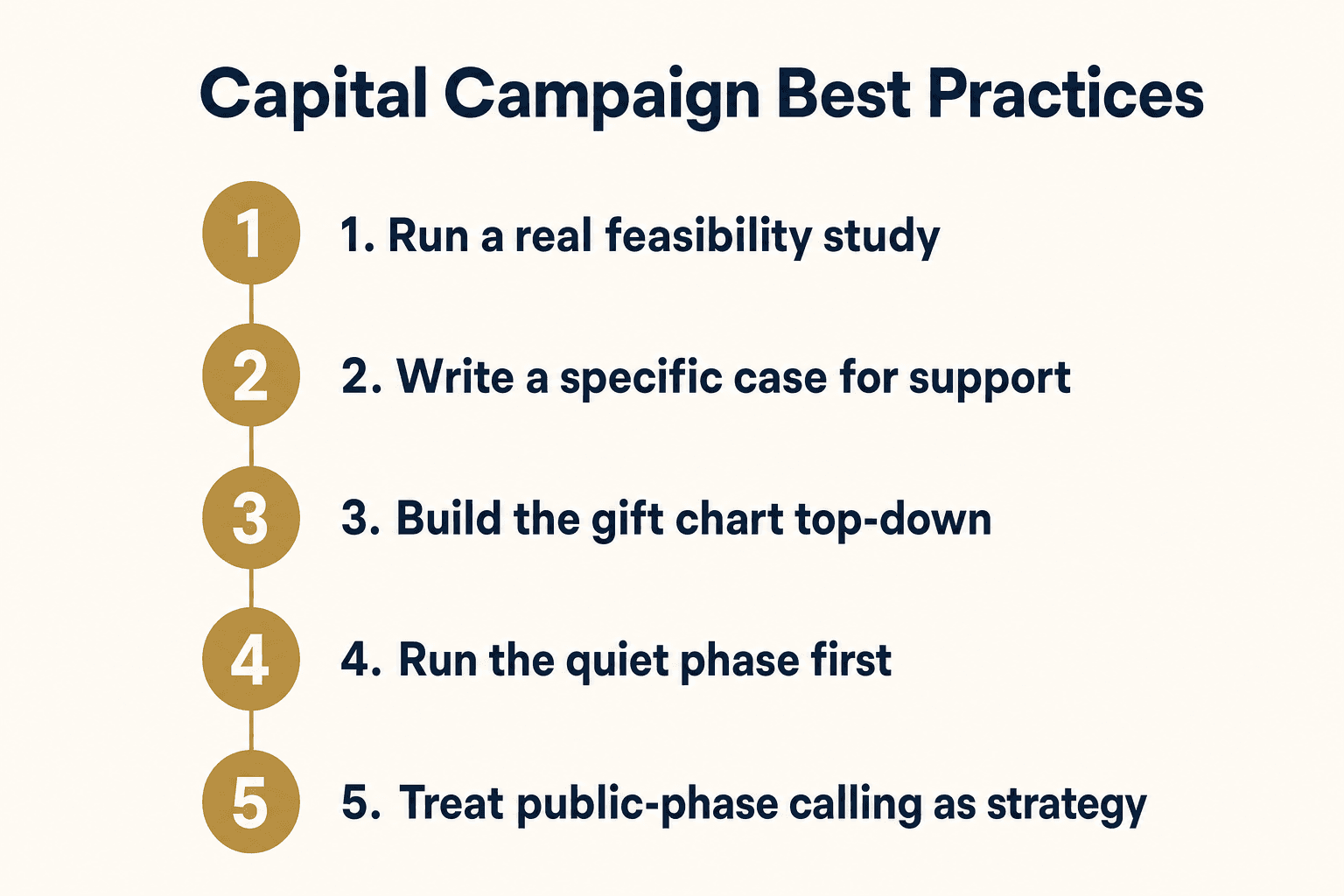
1. Start with a real feasibility study
A feasibility study interviews board members, top prospects, and community stakeholders before a dollar goal is announced publicly. It tests the case for support, surfaces objections early, and identifies which prospects are ready for a leadership gift conversation. Campaigns that skip this step, or treat it as a formality, are far more likely to fall short of goal or stall in the quiet phase.
2. Write a case for support donors can repeat back to you
The strongest case statements are specific: a named need, a clear dollar impact, and a timeline. Vague language about "building for the future" rarely moves a five or six-figure gift. Donors should be able to explain, in one sentence, exactly what their gift accomplishes.
3. Build a gift chart based on real prospects, not a template
Most successful campaigns follow a pyramid: a small number of lead gifts account for 40 to 60 percent of the total goal, a middle tier of major and mid-level donors fills the next third, and a broad base of annual donors completes the goal through the public phase. That chart only works if it is built from actual prospect research and capacity ratings, not a generic percentage template.
4. Run the quiet phase before you run the public phase
Securing 50 to 70 percent of the goal quietly, from board members and top prospects, before any public announcement builds momentum and de-risks the public ask. A public phase that launches with strong quiet-phase numbers already banked converts far more community and mid-level gifts than one launched from zero.
5. Treat public-phase calling as part of the strategy, not an afterthought
The public phase is where annual donors, lapsed donors, and community members are invited to participate. Trained callers who understand the campaign's case for support, not just a script, consistently produce higher participation rates and larger average gifts than untrained or outsourced calling programs with no context for the mission.
Mid-level donor engagement best practices
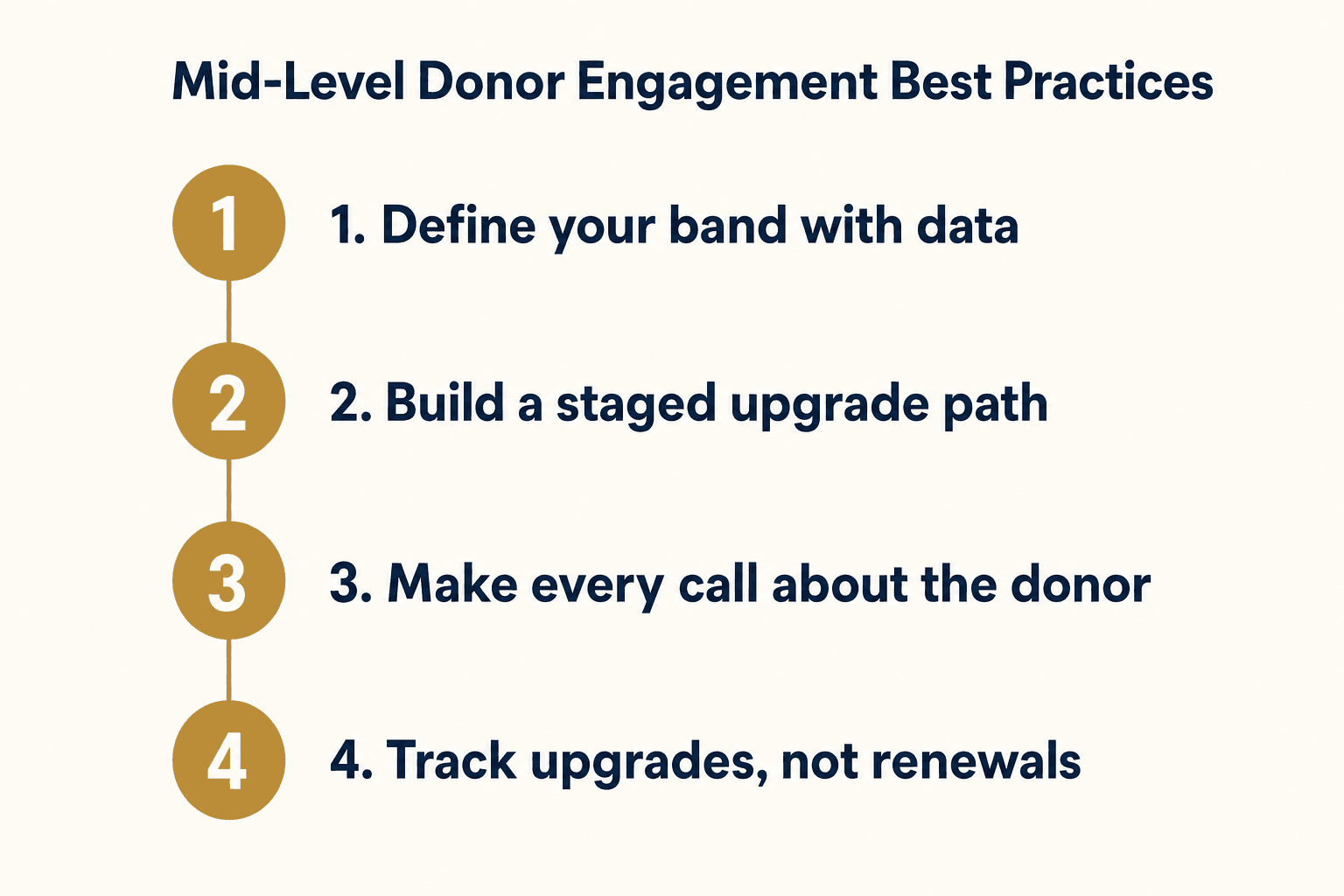
1. Define your mid-level band with data, not instinct
Mid-level donors typically give above the average annual gift but below major gift thresholds, often somewhere between a few hundred and a few thousand dollars depending on the organization's size. Pull the actual giving history to set that band, rather than guessing.
2. Build a staged upgrade path, not a single appeal
The strongest mid-level programs move a donor through stages of increasing personal contact, a welcome call, a stewardship touch reporting back on impact, a personalized ask, rather than sending the same annual appeal letter every donor receives. Catapult's mid-level program uses an 8-stage path built specifically to identify and cultivate donors ready to move toward a major gift conversation.
3. Make every call about the donor, not the ask
Mid-level donors respond to genuine recognition of their giving history and impact far more than to a transactional pitch. A call that opens with specific gratitude, and closes with a clear, reasonable next step, consistently outperforms a cold ask.
4. Track upgrades, not just renewals
A mid-level program's real measure of success is how many donors move up a giving tier year over year, not simply how many renew at the same level. Report on upgrade rate as its own metric.
Legacy giving and legacy call best practices
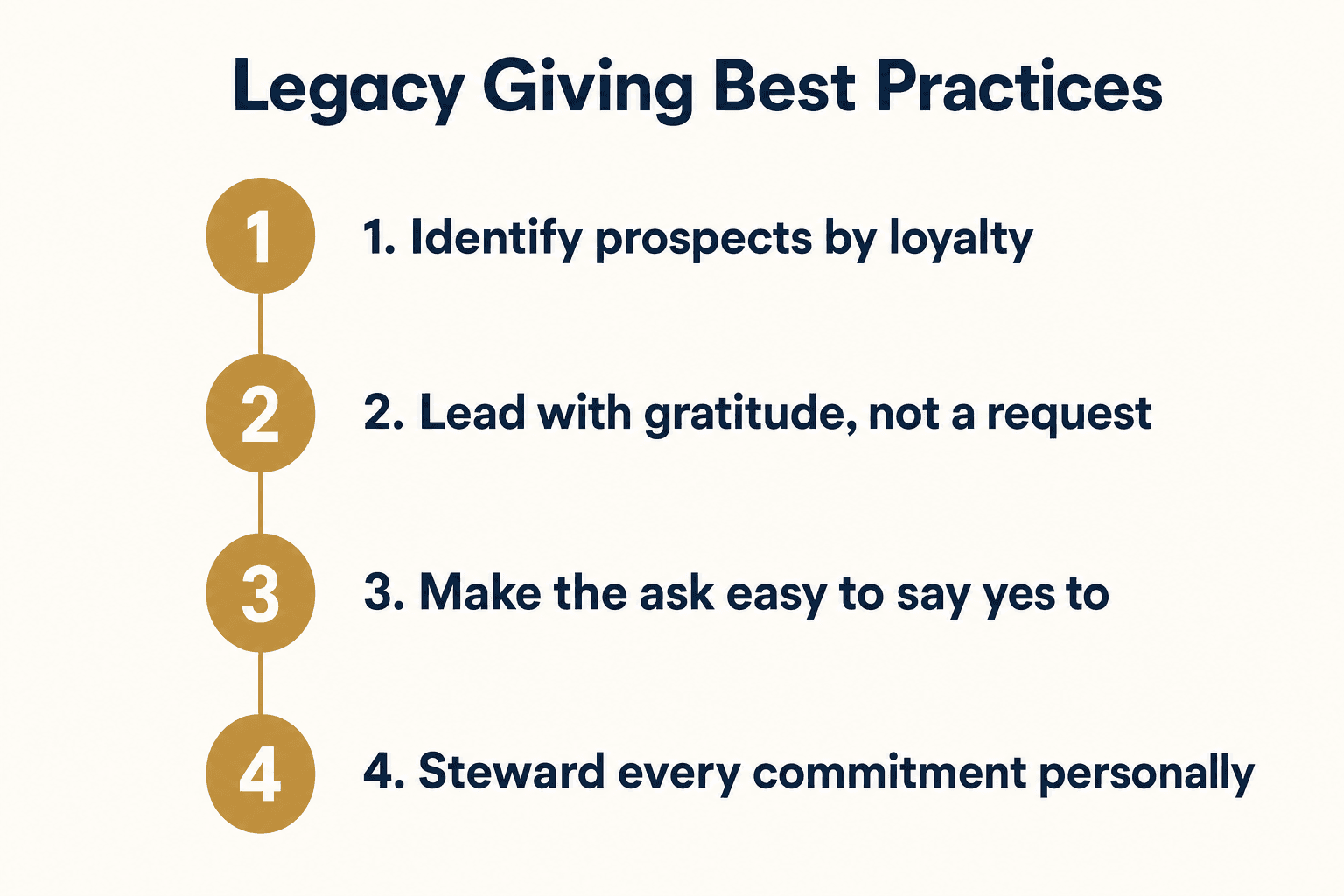
1. Identify prospects from loyalty, not just capacity
The strongest legacy giving prospects are often not an organization's largest annual donors. They are the donors who have given consistently, sometimes modestly, for a decade or more. Long tenure is frequently a better predictor of a future bequest than gift size alone.
Jeff Grandy explains how Catapult identifies that loyalty, and why non-consecutive givers belong on the list, on The Fund Raising School’s First Day podcast: Loyalty, Not Wealth: Finding Your Next Legacy Donor.
2. Lead with gratitude, not a request
An effective legacy call opens by thanking the donor for their specific giving history, not by asking for anything. The goal of the first conversation is almost always to open a relationship, not close a commitment.
3. Make the ask easy to say yes to
Many donors have already considered including a cause in their estate plans but have never been asked. A simple, low-pressure question, "Have you ever thought about including us in your will or estate plans?", often surfaces intentions the organization did not know existed.
4. Steward every legacy commitment publicly and personally
Donors who confirm a planned gift should be recognized (with their permission) and stewarded like any other major donor. Legacy giving societies, personal thank-you notes, and continued relationship-building all increase the likelihood that a stated intention becomes a realized gift.
How these three programs work together
A capital campaign builds the case and the momentum. Mid-level donor engagement identifies which annual donors are ready to give more, and more personally. Legacy giving captures the loyalty a strong mid-level and campaign program builds over years, converting it into deferred gifts that sustain the organization long after the campaign closes. Treated as one connected system, rather than three isolated initiatives, these programs compound: a well-run campaign creates better mid-level prospects, and a well-run mid-level program creates better legacy prospects.
Frequently asked questions
What is the first step in planning a nonprofit capital campaign?
A feasibility study. Before a case for support or a gift chart is finalized, a feasibility study interviews board members, major donors, and community stakeholders to test the campaign's goal, timeline, and case against real donor sentiment, so the public goal is set with evidence, not optimism.
How do you build a capital campaign gift chart?
Most successful campaigns follow a pyramid pattern: roughly the top 10 gifts account for 40 to 60 percent of the goal, the next tier of donors fills the middle, and a broad base of annual and mid-level donors completes the total through the public phase. The chart should be built from real prospect research, not a generic template.
What is mid-level donor engagement in fundraising?
Mid-level donor engagement is a structured program that identifies donors giving above the average annual gift but below major gift thresholds, then moves them through stages of increasing personal contact, stewardship, and ask sophistication, so more of them graduate into the major gift pipeline over time.
What makes a legacy giving or planned giving call effective?
Effective legacy calls lead with gratitude and relationship, not a hard ask. The best programs identify donors with long, loyal giving histories, thank them specifically for that history, and open a low-pressure conversation about how they might already be considering the organization in their estate plans.
Ready to put these practices to work for your organization? Start a conversation with Catapult Fundraising.