By Amy C. Wiles, Chief Campaign Strategist, Catapult Fundraising

Most fundraising conversations begin with the wrong question.
They begin with, “How do we persuade someone to give?”
I think there is a better question: “What helps someone feel ready to act on something they already care about?”
After years of working with donors and organizations on campaigns, I have found that people rarely give simply because an organization has a need. They give when they understand the need, trust the organization, feel personally connected to the work, and believe their gift can actually make a difference.
That sounds simple. In practice, it is where a lot of fundraising either works or falls apart.
Giving is rarely just about money
A major gift is not a transaction. It is part of a relationship.
People give for all kinds of reasons. Sometimes it is something that happened to them personally. Sometimes it involves a family member. Sometimes it is a place, a person, or a cause that has been part of their life for years.
- Someone who adopted a senior animal may have a very different connection to an animal shelter than someone who has never had that experience.
- A family that struggled to find mental health care may look at a new crisis facility very differently from someone who has never needed those services.
- An alumnus who had no other path to a college education may understand the importance of expanding access in a way that statistics alone never could.
The gift gives that person a way to do something about what they care about.
That is why I am not a big believer in generic appeals. “We need your support” may be true, but it does not answer the more important question: Why should this particular donor care?
Sometimes the best fundraising message has very little to do with the building, the campaign goal, or the organization’s budget.
It has to do with the person whose life changes because of it.
Trust comes before the ask
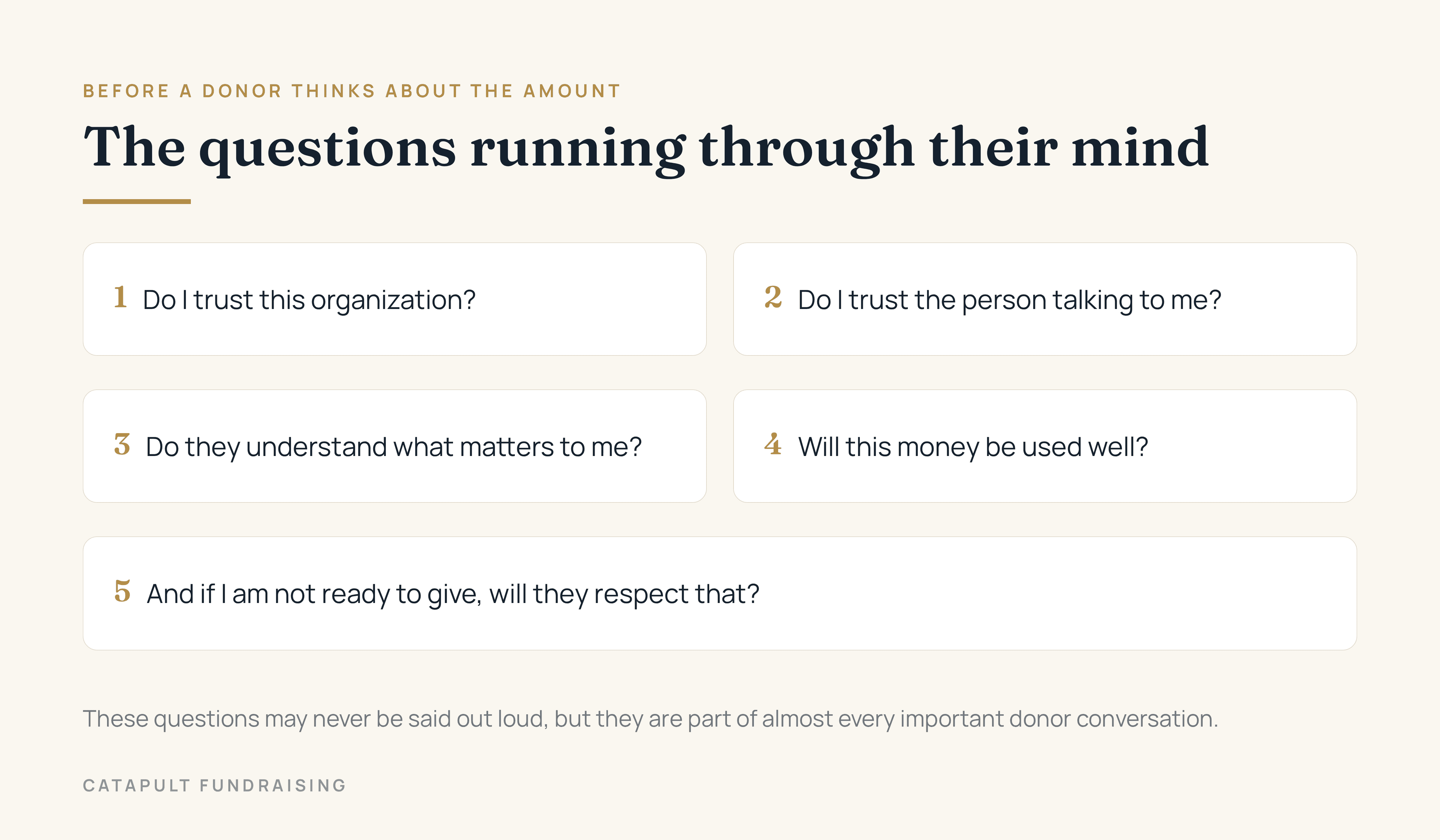
Before a donor thinks about the amount of the gift, there are usually other questions running through their mind. Do I trust this organization? Do I trust the person talking to me? Do they understand what matters to me? Will this money be used well? And if I am not ready to give, will they respect that?
Those questions may never be said out loud, but they are part of almost every important donor conversation.
Trust is built by doing the basics well. Be prepared. Know the donor. Listen. Follow up. Do what you say you are going to do. Respect the process.
I have been in plenty of donor meetings where the conversation went somewhere we did not expect. We went in thinking we knew what interested the donor, only to discover that their real connection to the organization was something completely different.
That is why I believe the best fundraisers listen more than they talk.
One of the things we emphasize in campaign training is that the visit should begin with building rapport, showing the need and the solution, and asking good questions. The actual “ask” should only take a few minutes. The rest of the meeting is about understanding the person sitting across the table.
A donor may say they are interested in workforce development, but the real story may be a parent who struggled to find work.
A museum donor may talk about preserving history, but what really matters is a family tradition that goes back generations.
Those are the moments you want to find. Often, that means putting the folder down and listening.
Personalization is not a trick
Personalization is often treated as a marketing tactic. Use the donor’s name. Mention their last gift. Reference something from their email.
That is the easy part.
Real personalization means understanding why someone is connected to your organization and then approaching them accordingly.
Is this person a volunteer? An alumnus? A longtime member? Someone who has attended your events for years? A business leader? A family member of someone you served? Or someone who has only recently become interested in the organization?
Those distinctions matter. Capacity matters, too, but capacity by itself does not make someone a good prospect.
When I look at a major gift prospect, I am usually thinking about three things.
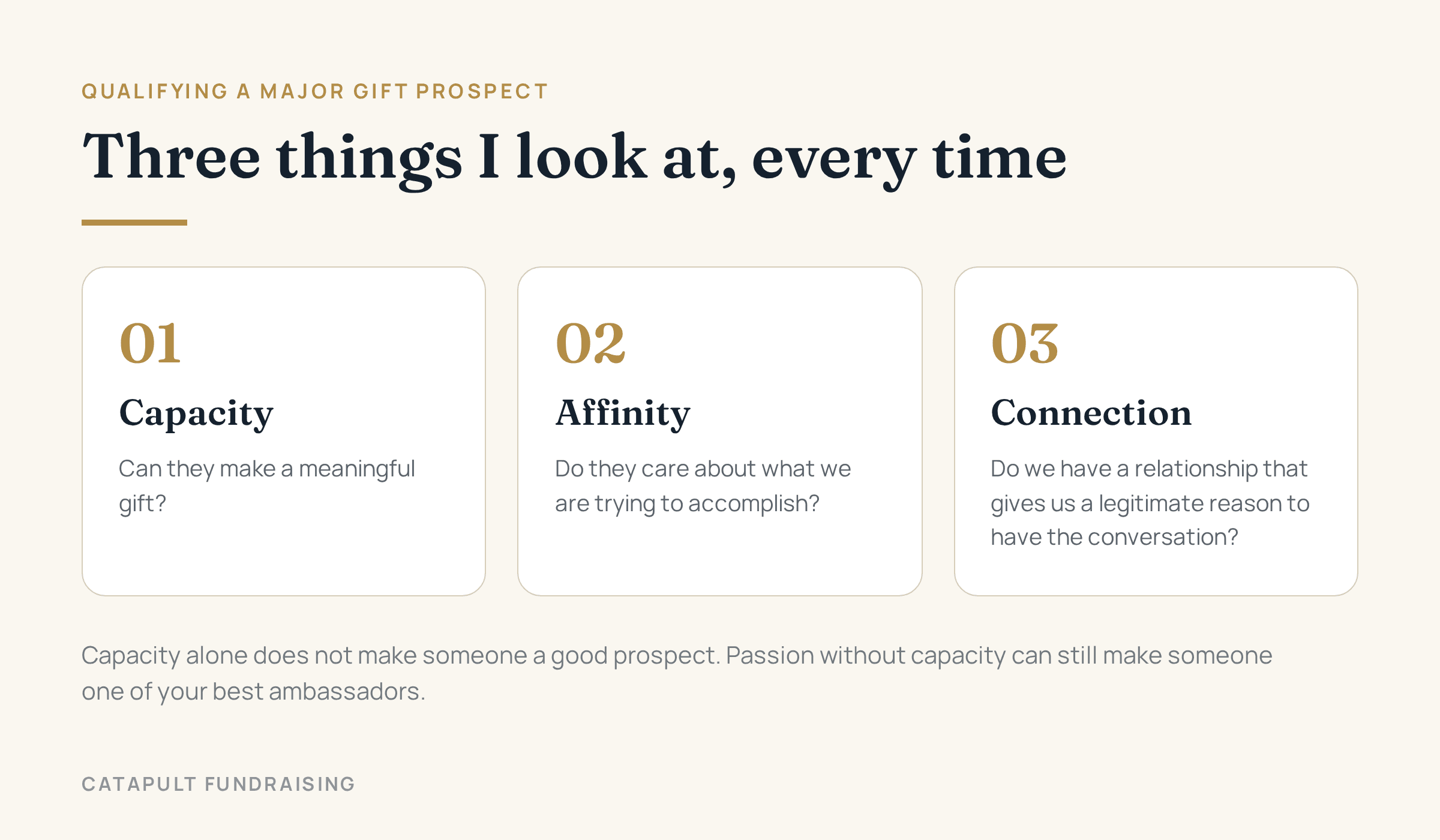
A wealthy person with no interest in your mission may not be a good prospect. Someone with tremendous passion but limited financial capacity may be one of your best ambassadors. And a donor who has both capacity and affinity may still need more time or a different relationship before they are ready for a major ask.
Personalization also continues after the meeting. A thoughtful follow-up that refers to something the donor actually said tells them that the conversation mattered.
It says, “We heard you.” That goes a long way.
Urgency only works when it is real
I believe in urgency. I do not believe in manufactured urgency. There is a big difference.
Real urgency might be a family in crisis that has nowhere nearby to turn. It might be a historic building that needs to be saved. It might be students traveling long distances because the education they need is not available closer to home.
It might also be a matching gift that gives donors an opportunity to double the impact of their contribution.
Whatever the situation, the donor should understand why now matters. Compare:
The organization’s problem
“We need to close our funding gap by December 31.”
The difference the donor can make
“This project will give families in crisis a place to go close to home.”
That distinction matters.
Good fundraising does not have to make people feel guilty or pressured. It needs to help them understand what is at stake and why their participation matters now.
Give the donor a place in the story
One of the biggest mistakes I see in cases for support is that the organization spends so much time talking about itself that the donor disappears from the story.
A good case should answer some basic questions.
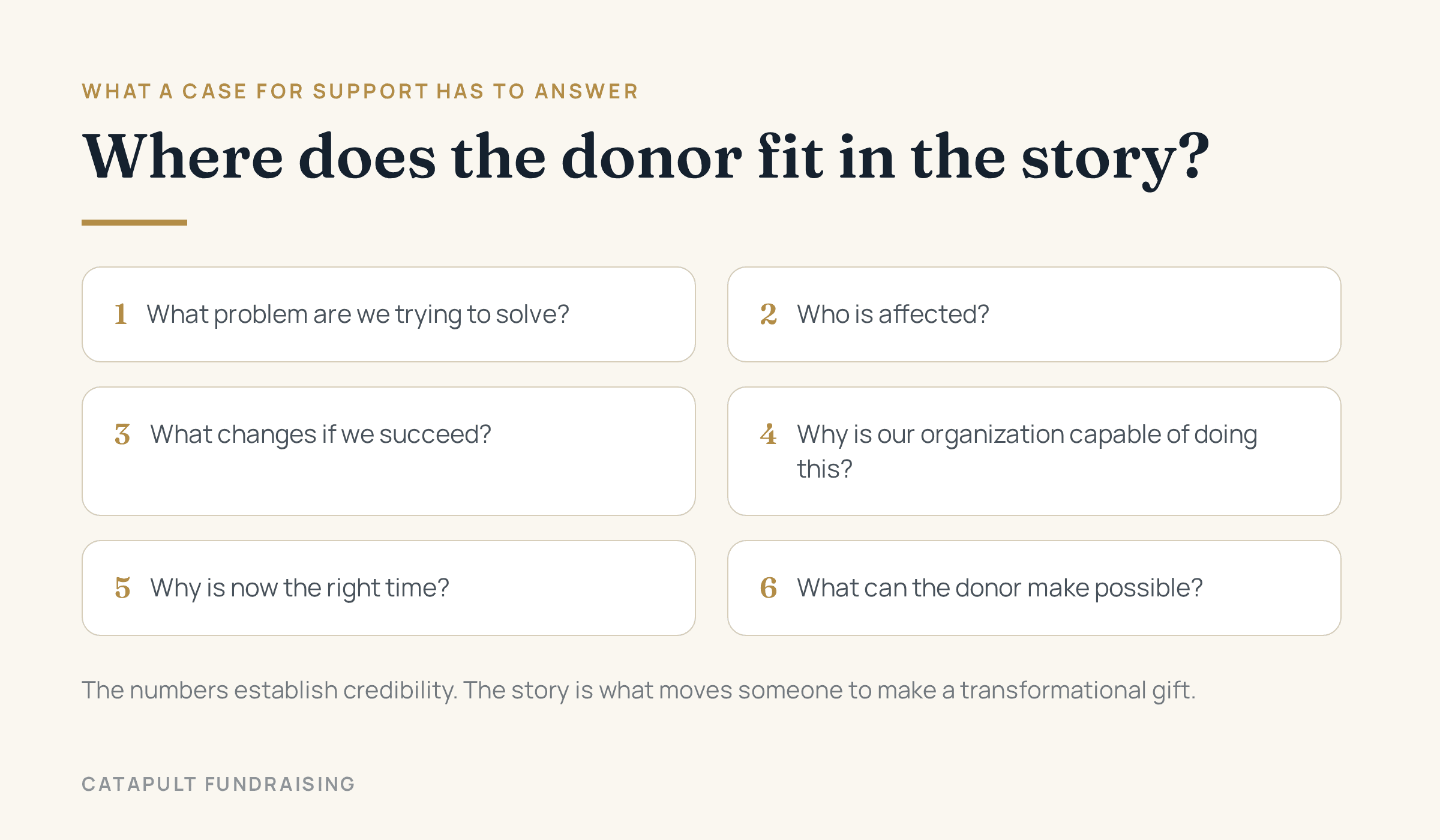
The numbers matter. They establish credibility. But numbers alone rarely move someone to make a transformational gift. The story matters, too.
In a recent feasibility study interview, one of the people we spoke with described the one-page case we had developed as particularly effective because it combined evidence with a compelling human story and made the organization’s future easier to understand.
That is what you want a case to do. Tell me why this is important. Show me that you know what you are doing. Then help me understand where I fit.
The ask is an invitation
A lot of fundraisers are uncomfortable asking for money. I understand that. Nobody wants to feel like they are putting someone on the spot.
But a good ask is not about putting pressure on someone, the proverbial “arm twisting.” It is about giving a donor the opportunity to participate in something they care about.
The ask should be made by someone who has a credible relationship with the donor. It should be based on what we have learned about that donor. It should be specific about the amount and what the gift will accomplish.
And then you have to be willing to stop talking.
Silence is hard. After you ask for a major gift, there is a natural temptation to fill the space. Don’t. Give the donor a chance to think.
They may be thinking about their finances. They may be talking it over with their spouse. They may be considering another commitment. Or they may simply need a minute to absorb what you have asked them to do.
Let them have that minute.
The goal is not to talk someone into giving. The goal is to give them enough information, trust, and space to make a decision they feel good about.
Legacy is about meaning
Not every donor cares about having their name on a wall. Many donors care much more about what their gift represents.
A donor who lost a loved one may want to support a program that helps other families facing the same experience. A family that built a business in a community may want future generations to see what that community meant to them. A longtime supporter may want to make sure that something important to their own life is still here for the next generation.
Naming opportunities and recognition can be meaningful, but the name is not really the point. The meaning behind it is.
The better question is not, “What recognition can we give this donor?” It is, “What can this donor make possible that will still matter years from now?”
The bottom line
People give for different reasons, but three things show up again and again in successful fundraising conversations.
- They feel connected to the people and purpose behind the work.
- They feel confident that the organization and its leadership can deliver.
- And they see a real opportunity to make a difference.
Our job as fundraisers is not to manufacture those feelings. It is to understand them.
Ask good questions. Listen carefully. Know the donor. Be honest about the need. Explain what the gift will accomplish. Give people room to make their own decisions.
And remember that a donor who says, “not now” has not necessarily said “never.” Some of the best donor relationships I have seen have developed over time because a fundraiser respected the person enough not to force the moment.
The best gift conversations leave the donor feeling respected, whether they give today, later, or in another way.
That is not just good fundraising. It is how good relationships are built.
Catapult Fundraising helps nonprofits build campaigns, cases for support, and donor conversations around what actually moves people to give. If you would like to talk about your next campaign or major gift program, we’d love to start the conversation.
This article reflects Amy C. Wiles’ experience leading campaigns and donor conversations at Catapult Fundraising. Examples are drawn from that work and are described without identifying clients or donors.