By Jeff Grandy, Vice President of Client Development, Catapult Fundraising

Launching a capital campaign is a major commitment. It requires board leadership, staff capacity, a compelling case for support, disciplined prospect strategy, and the confidence to ask donors for transformational gifts.
I’ve been doing this long enough to know campaigns rarely struggle because the mission is weak. They struggle because nobody stopped to check whether the goal, leadership, project, and donor base actually lined up before the campaign went public.
A feasibility study is how you check.
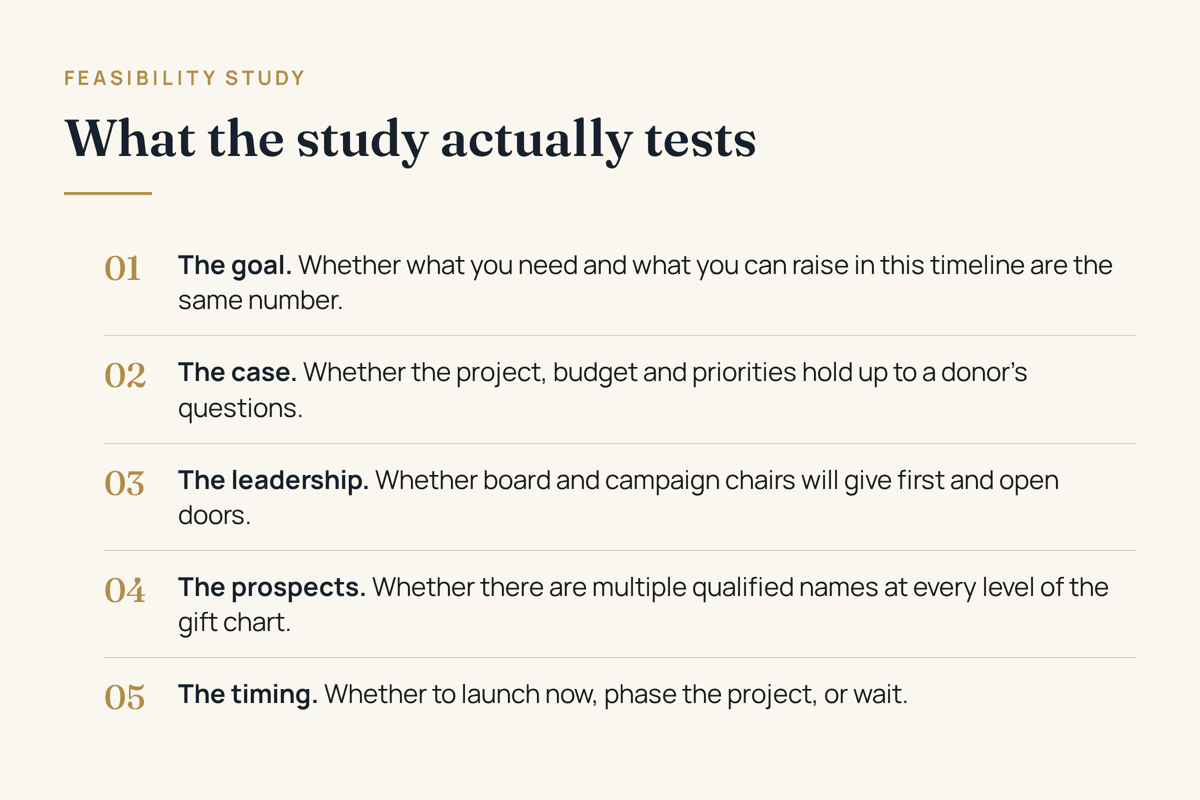
It is not a test of whether donors like the project. Most people are polite. They will tell you they like the project. What matters is whether they believe the vision is clear, the leadership is credible, the goal is realistic, and the right donors are willing to engage.
Those answers are much harder to fake.
Setting a goal you can actually reach
Most organizations begin a campaign conversation with a number based on need. That makes sense. A new facility costs what it costs. A program expansion has a real price tag.
But what an organization needs and what it can raise within a particular timeline are two different questions. A feasibility study helps leadership reconcile those two realities before a goal is printed, promised, or announced.
I worked on an endowment campaign with an initial goal range of $8 million to $12 million. We designed the plan so the final goal would be based on what we learned through the feasibility process. We also left room to extend the quiet phase if the findings showed the organization needed more time to develop major gift prospects.
That flexibility is not a lack of confidence. It is good campaign planning.
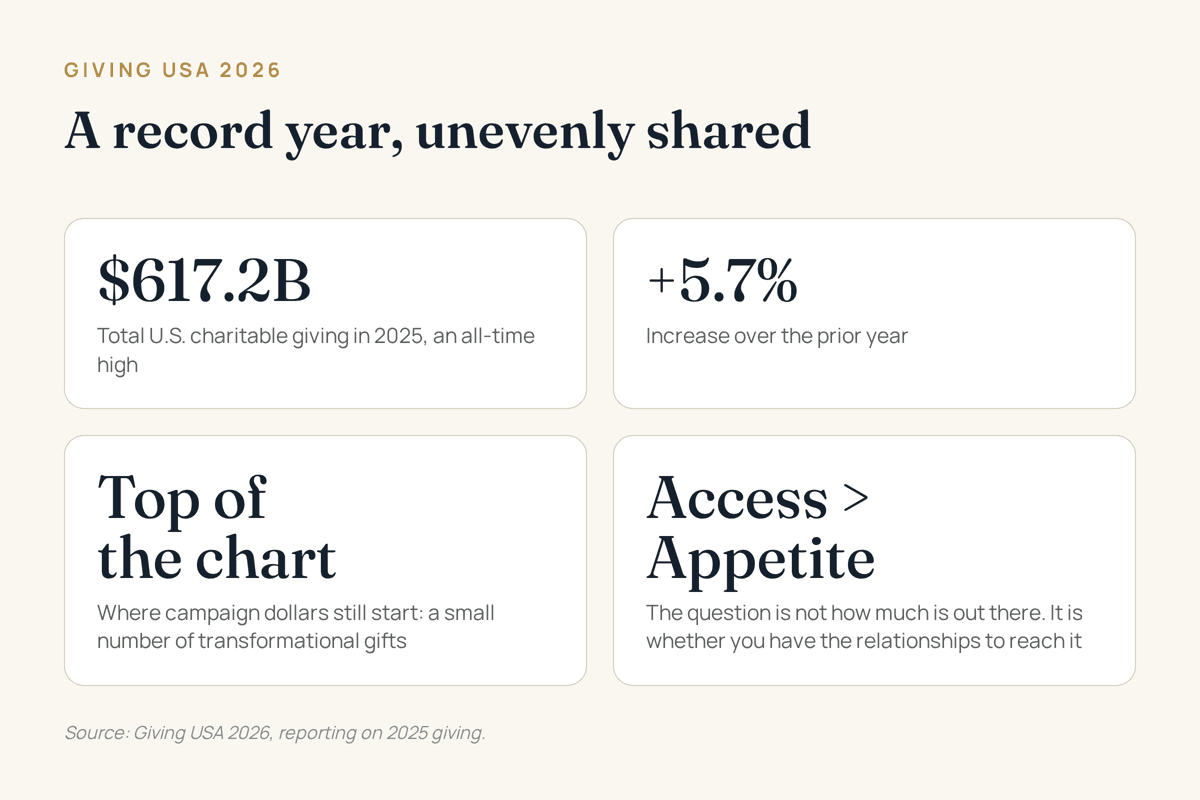
Giving USA reported that charitable giving in the United States reached $617.2 billion in 2025, an increase of 5.7% over the prior year. That is encouraging, but it does not mean every organization has equal access to those dollars.
Capital campaigns still depend on a relatively small number of donors willing and able to make transformational gifts. The real question is not only how much you need. It is whether you have the relationships, leadership, and strategy to raise it.
Finding the weak spots while you can still fix them
A polished brochure does not raise money on its own. Clear priorities, credible leadership, strong donor relationships, a realistic gift chart, and a case for support people genuinely believe in are what raise money.
A feasibility study shows you which of those pieces are in place and which need work. That might mean refining the project scope, strengthening the case, recruiting campaign leadership, cleaning up donor data, or building a deeper prospect pipeline.
On one campaign, we could not move into serious fundraising until the organization settled several fundamental questions involving land, project costs, the business plan, and construction phases.
None of those questions was particularly glamorous. Capital campaign planning rarely is. But each answer affected what the organization could credibly present to donors.
That is the value of doing this work early. It is much easier to solve a problem before a campaign becomes public than after donors have already been asked to invest in it.
Letting donors and community leaders talk first

A well-run feasibility study creates space for confidential conversations with the people who matter most: major donors, board members, former leaders, foundation representatives, community partners, and potential campaign volunteers.
Those conversations provide much more than a dollar estimate. They tell you how people see the organization, whether the vision connects, what concerns need to be addressed, and who may be willing to lead.
I advised on a campaign where community confidence had declined after a lengthy closure. In that situation, visible progress mattered as much as anything we could put in the case for support. The planning process allowed us to hear those concerns before asking anyone for a major gift.
Sometimes the most important thing you learn is not how much someone might give. It is what must happen before that person is ready to consider giving at all.
That is valuable information, even when it is not the answer everyone wanted to hear.
Determining whether leadership is ready
Major gifts happen because of relationships, not paperwork. A campaign needs board members, committee members, and campaign chairs who are willing to open doors, tell the story, and participate in donor conversations.
I tell boards much the same thing every time:
- Confirm the need before anything else moves
- Approve the campaign policies so the rules are settled early
- Make your own gift, and make it first
- Attend cultivation events where donors can see you
- Help the community believe in the vision
Donors read the room. They pay attention to the people behind the campaign as closely as they examine the project.
A feasibility study helps determine whether that leadership is present. It can also identify people who may serve as campaign chairs, connectors, advocates, or volunteers. Not everyone needs to be the person who asks for the gift. Some people create far more value by opening the right door and helping someone else walk through it.
Testing the prospect strategy
The early dollars in a campaign generally come from a small number of large gifts. There is no clever workaround for that. It is simply how capital campaigns work.
That is why I begin prospect strategy at the top of the gift chart. Do we have multiple qualified prospects at each leadership level? Do we understand their capacity, interest, and relationship with the organization? Or did someone put their name on a spreadsheet because they once attended a luncheon?
A name is not a prospect strategy.
The feasibility process tests those assumptions through research and confidential conversations. It helps an organization distinguish between people who appear capable of giving and people who have the connection, interest, and trust necessary to consider a significant investment.
A campaign’s outcome may depend on a handful of relationships. Leadership should know who those people are and where they stand before announcing the campaign publicly.
Knowing when not to launch
The purpose of a feasibility study is not to produce a predetermined yes.
Sometimes the responsible recommendation is to adjust the goal, phase the project, strengthen the case, recruit additional leadership, develop more prospects, or wait. That is not failure. It is good judgment.
Launching before the case is clear, the budget is credible, the leadership is committed, and the prospect base is qualified creates unnecessary pressure for staff and volunteers. It can also damage donor confidence in ways that take years to repair.
Occasionally, circumstances make a traditional feasibility study impractical. I worked with one organization that needed to move quickly after a two-year closure had weakened community confidence. The timeline did not allow for a full study, so we conducted an accelerated readiness assessment focused on the same essential questions:
What would the project cost? Who were the strongest prospects? Who would lead? Was the case credible? Were donors ready to engage?
The format can change when circumstances demand it. The discipline cannot.
Moving forward without answering those questions does not save time. It simply moves the risk to a point in the campaign where fixing the problem becomes more difficult and more public.
The study is not a delay. It is the first move.
Do not think of a feasibility study as something that slows a campaign down. It is the first serious investment an organization makes in getting the campaign right.
It turns enthusiasm into a plan: a realistic goal, a stronger case, defined leadership roles, a qualified donor pipeline, and a roadmap for securing the first gifts.
Every organization I have seen struggle after skipping this work had a worthwhile mission. The problem was not the mission. Leadership had never determined whether the goal, project, people, and donors were moving in the same direction.
A feasibility study gives you the opportunity to find out while there is still time to do something about it.
Catapult Fundraising conducts capital campaign feasibility studies, readiness assessments, and full capital campaign consulting for nonprofits across the country. If you are weighing a campaign and want an honest read on whether you are ready, let’s start the conversation.
Sources: Total giving figures are drawn from Giving USA 2026, reporting on 2025 giving, Indiana University Lilly Family School of Philanthropy. Campaign examples reflect Catapult Fundraising’s own client experience and are not industry-wide statistics.