
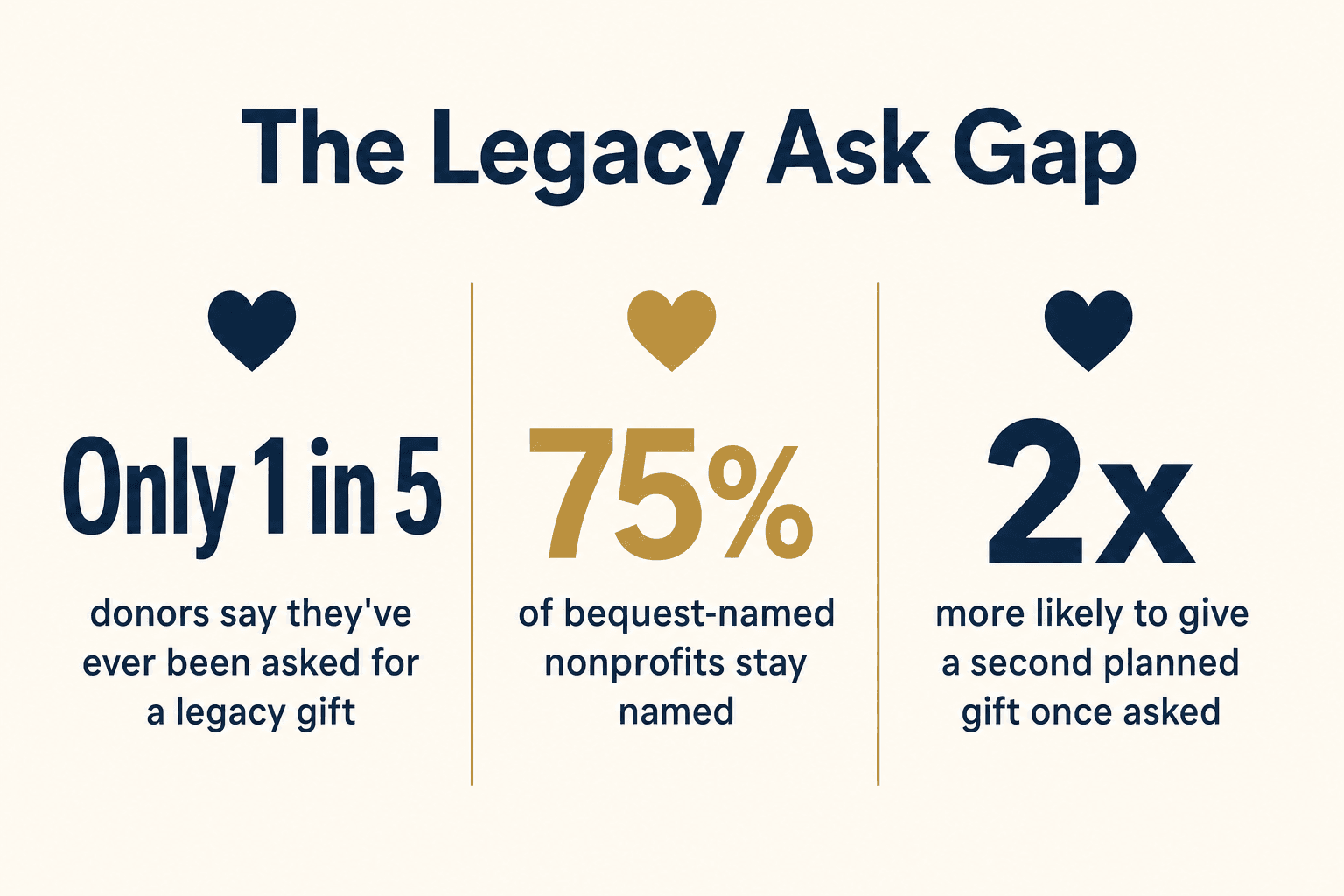
Bequests are widely considered the major gift of the average American, gifts far larger than a donor could ever make in a single year, and yet most organizations spend almost no budget or time pursuing them. Roughly a third of Americans say they’d consider a charitable bequest, and once a nonprofit is named in a will, it tends to stay there about 75 percent of the time. Donors who make one planned gift are also twice as likely to make a second, if they’re asked.
Almost everyone has the ability to make a bequest, even if it’s a portion of their estate. The people most likely to leave one aren’t your biggest annual donors, they’re the people who’ve given loyally for fifteen, twenty, even forty consecutive years.
Identify prospects by loyalty, not wealth
Build your legacy prospect list from consecutive years of giving first: donors with twenty-plus consecutive years, then fifteen-plus, then ten-plus, layered with those who attend events or volunteer. Add donors with twenty or more total gifts even if not fully consecutive. For most organizations, this exercise surfaces roughly 10 percent of the database as strong legacy prospects, closer to 25 percent for faith-based or children’s organizations. Wealth screening still has a role, mainly to prioritize who to call first when budgets are limited, but household income is a weak predictor on its own: most people who make a planned gift have household incomes under $200,000. Loyalty and belief in the mission, not capacity, is what actually predicts a bequest.
A two-step call process that doesn’t require a planned giving expert on staff
Eighty percent of all planned gifts are simple bequests, you don’t need deep technical expertise to start these conversations, only a process. Here’s the structure:
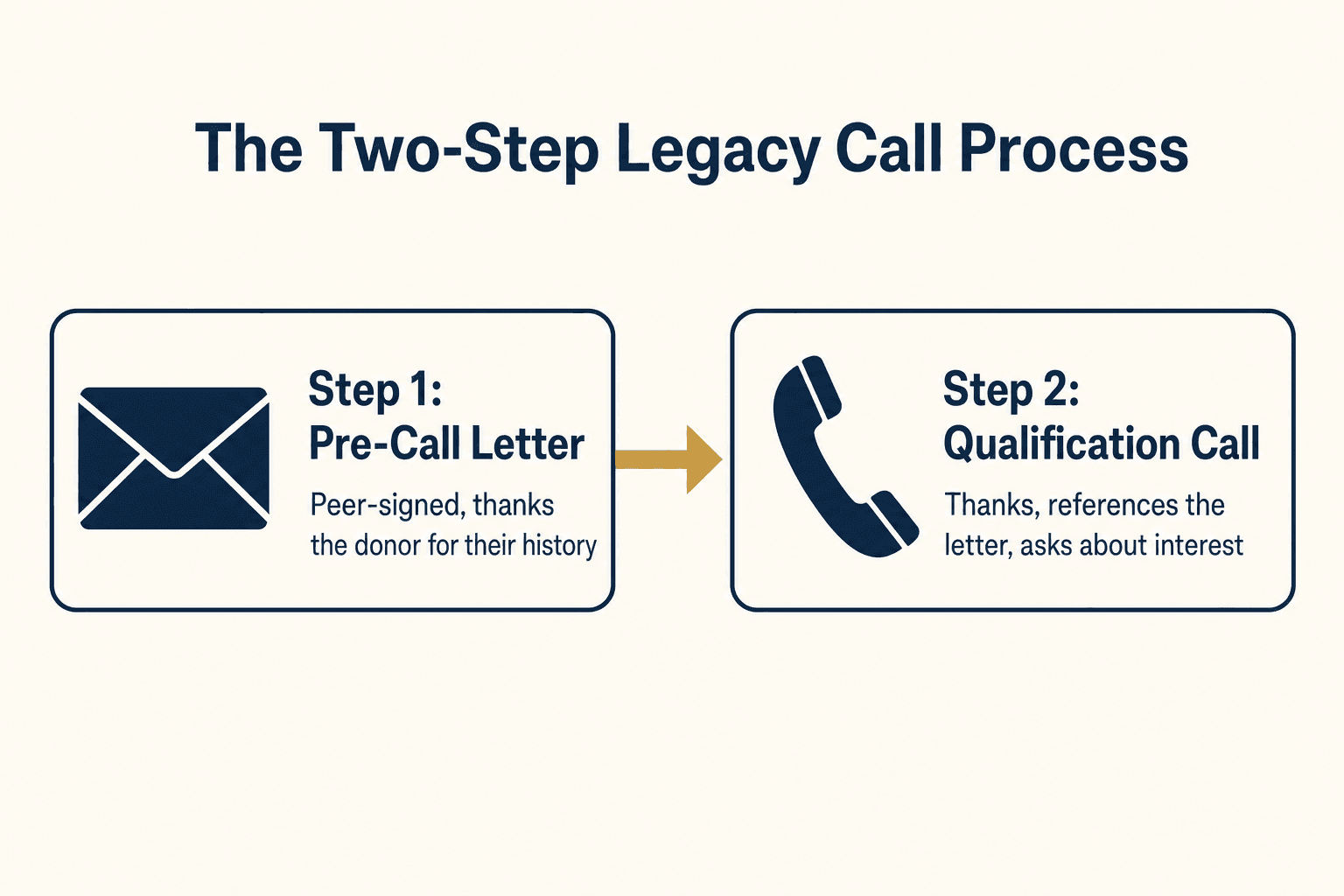
- Send a pre-call letter signed by a peer volunteer, someone whose own story of giving matches the prospect’s profile, that thanks the donor for their giving history and tells the case for support from a donor’s perspective. Longer letters, two to three pages, consistently outperform shorter ones. A digital voicemail drop from the CEO ahead of the letter adds credibility.
- Make a qualification call that simply thanks the donor, references the letter, and asks whether they’d be open to a further conversation about a legacy gift. This caller doesn’t need planned giving expertise, their job is gratitude and interest, not a technical conversation.
- Hand interested donors to a gift-planning specialist for a second conversation. Expect roughly 20 percent of qualification calls to advance to this stage, and expect those conversations to take three to six touches to close, similar to a major gift solicitation. Some donors will already have the organization in their will and simply never told anyone, an important signal to start stewarding that relationship differently.
The return on investment is real
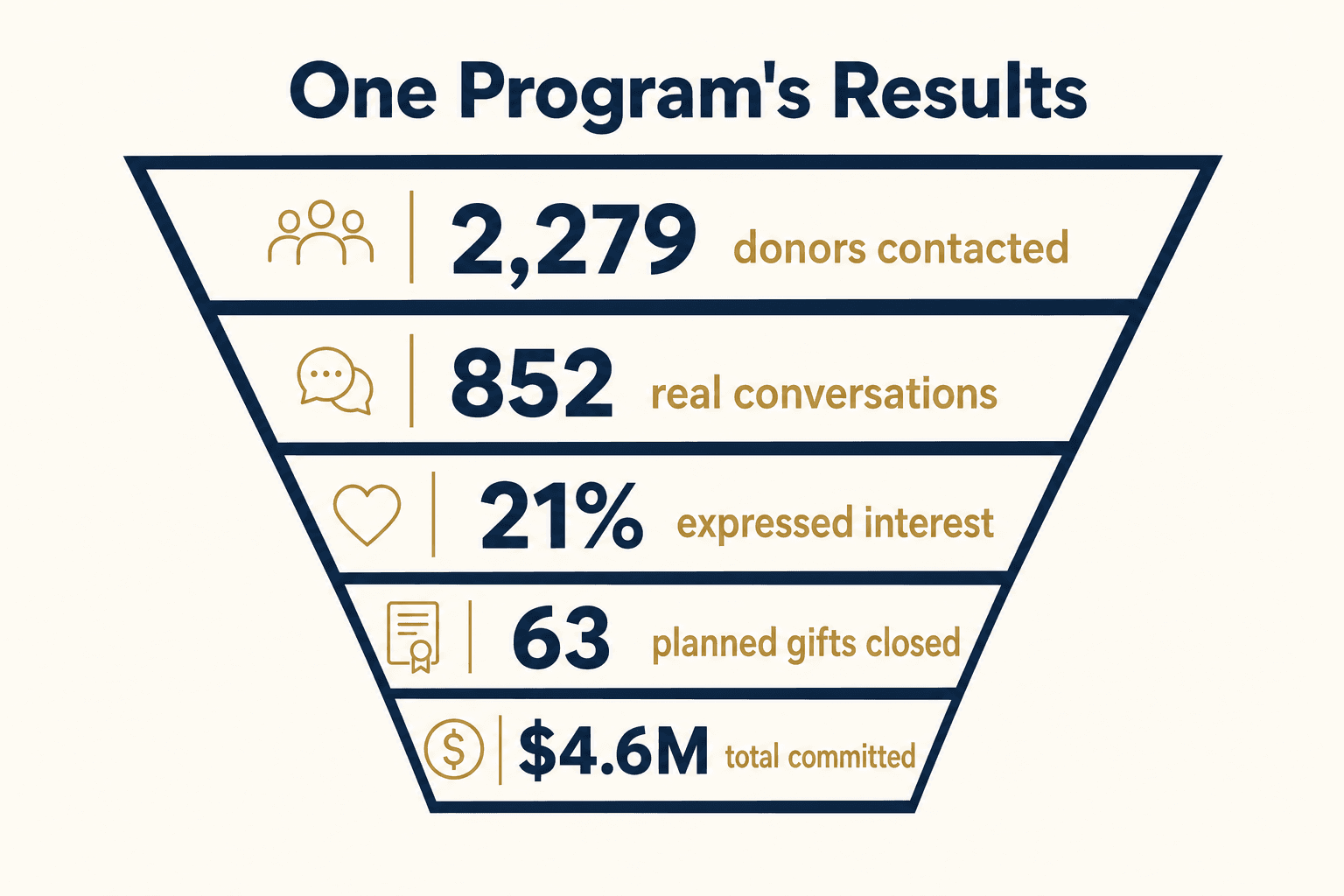
In one recent program for a public broadcasting client, outreach to 2,279 long-time donors produced 852 real conversations, 21 percent of which expressed interest in a legacy gift, and ultimately closed 63 planned gifts totaling $4.6 million, against a program cost in the range of $160,000 to $170,000. Even setting aside the dollars closed, every one of those calls accomplished the baseline goal: thanking a loyal donor for years of support they’d never been properly acknowledged for.
Thousands of loyal donors are waiting to be asked. If we do nothing else through this process but thank a donor for twenty consecutive years of giving, it’s already a success.
If a full two-step program isn’t realistic yet, start smaller: call five of your most loyal long-tenured donors every morning, just to thank them and ask how they’re doing. Something is always better than nothing, and legacy donors who feel genuinely stewarded tend to increase their annual giving six to seven times over as a direct result.
For more on how to spot those donors and open the first conversation, Catapult Vice President Jeff Grandy walked through the loyalty signals and the opening call on The Fund Raising School’s First Day podcast: Loyalty, Not Wealth: Finding Your Next Legacy Donor.
What happens after someone joins your legacy society
About 20 to 25 percent of the loyal donors we call already have the organization in their will. The organization just didn’t know. Finding them is the first win. What you do next decides whether that gift is still there when the estate is settled.
When a donor tells us they’ve included you, we ask for a simple will confirmation form or a copy of the page that names you. About half the time we get it. The other half will confirm the gift but keep the amount private, and that’s fine. Some answers take time: “Let me talk to my attorney,” or “Let me talk to my financial advisor.” Our planned giving specialists keep that conversation going, sometimes for up to two years.
Then we hand those donors back to you, and stewardship begins. Your legacy society should not be a list in a drawer. Give each member five to seven real touches a year:
- A thank-you call with no ask attached
- A birthday call or card
- A handwritten note, a real one
- An invitation to a legacy society luncheon or event
- An update on the work their future gift will carry forward
Donor loyalty isn’t about the donor being loyal to us. It’s about us being loyal to the donor. Legacy society members who feel that loyalty tend to give more while they’re living, too.
If you’re ready to begin asking, start with how to start a planned giving program, or see how our planned giving consulting and Legacy Call program works.
Ready to find out how many legacy prospects are already sitting in your database? Start a conversation with Catapult Fundraising.